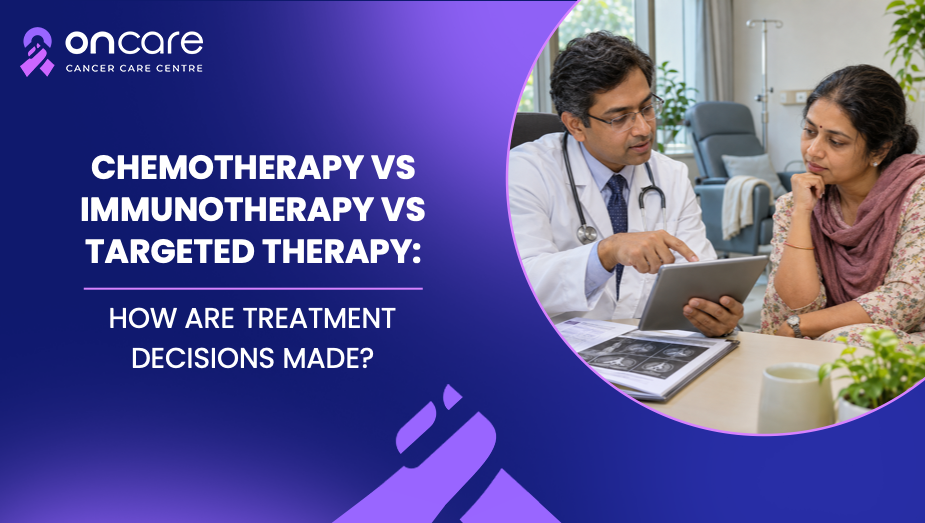
As Lung Cancer Awareness Month puts the spotlight on early diagnosis, Oncare Cancer Hospital explains how doctors decide between chemotherapy, immunotherapy and targeted therapy, and why families deserve to understand that choice before treatment begins.
When a family hears the word "cancer", the next words they usually hear are chemotherapy, immunotherapy and targeted therapy. One relative has read about a "new injection" online. A neighbour's father had chemo and found it very hard. Someone has forwarded a video about a "miracle drug". And in the middle of all that, the patient is quietly asking: which one is right for me, and why?
This Lung Cancer Awareness Month, campaigns across the country are urging people to get screened and diagnosed early. Oncare Cancer Hospital, a multi-city cancer care provider with centres across Delhi NCR and Bengaluru, says the conversation can't stop at diagnosis. Families also need to understand how treatment is chosen, because they are more likely to stick with a decision they understand.
The hospital does not believe in one best cancer treatment. It is more about finding what fits the person and their cancer, along with how far it has progressed. That choice needs some explanation behind it.
What each treatment actually does:
- Chemotherapy uses medicines that attack fast-dividing cells, which is why it works against many cancers and why it can also affect hair, the gut, and blood counts. It remains the backbone of treatment for many cancers, either on its own or alongside other options.
- Targeted therapy works on specific changes, or mutations, inside cancer cells. It only makes sense when testing shows the target is actually present. In lung cancer, for example, testing a tumour sample for gene changes such as EGFR or ALK can show whether a targeted medicine is likely to help.
- Immunotherapy helps the body's own immune system recognise and attack cancer cells. It can work very well for some cancers and some patients, and not at all for others, which is why doctors look at specific markers and the overall picture before recommending it.
How the decision is actually made:
Type and stage come first. The same drug can be the right choice for one cancer and the wrong one for another. Where the cancer started, and how far it has spread, shape every option that follows.
Testing the tumour, not guessing. Oncare says molecular or biomarker testing on the biopsy sample can guide whether targeted therapy or immunotherapy is worth considering. That testing is what separates a treatment that fits from one that simply sounds advanced.
The patient, not just the scan. Age, other health conditions, how well they are managing daily life and what they want from treatment all matter. A plan that looks perfect on paper but is too demanding for the patient to complete is of little use.
Cost. Newer therapies such as immunotherapy can cost significantly more. Oncare says it will discuss likely costs as part of planning, so families can make an informed choice about their options rather than discover the cost after treatment has started.
Often, it's a combination. Many patients receive more than one type of treatment, together or one after another, alongside surgery or radiation where needed.
"Families often walk in believing the newest treatment must be the best one," said a spokesperson for Oncare. "Sometimes it is. Often, chemotherapy is still exactly what's needed. Our job is to explain why a particular plan fits a particular patient, so they're not choosing based on fear or a forwarded message, but on what their own reports actually show."
Oncare encourages patients and families to ask three questions before starting any cancer treatment: what is the goal of this treatment, why is it the right option for my cancer and stage, and what will it cost over the full course?
Patients seeking a consultation, a second opinion, or a treatment plan can connect with an Oncare specialist directly.
About Oncare Cancer Hospital
Oncare Cancer Hospital is a multi-city cancer care provider with centres across Delhi NCR (Ghaziabad, Gurugram, Noida, South Delhi and West Delhi) and Bengaluru (Basavanagudi, Kalyan Nagar, Rajajinagar and Whitefield), focused on delivering affordable, quality cancer care. Through its centres and partner hospitals, Oncare offers oncology services including surgical oncology, chemotherapy, radiation therapy, immunotherapy, targeted therapy and precision oncology. Before treatment begins, patients and their families are taken through the treatment plan and its estimated costs, so they can make informed decisions without financial surprises.