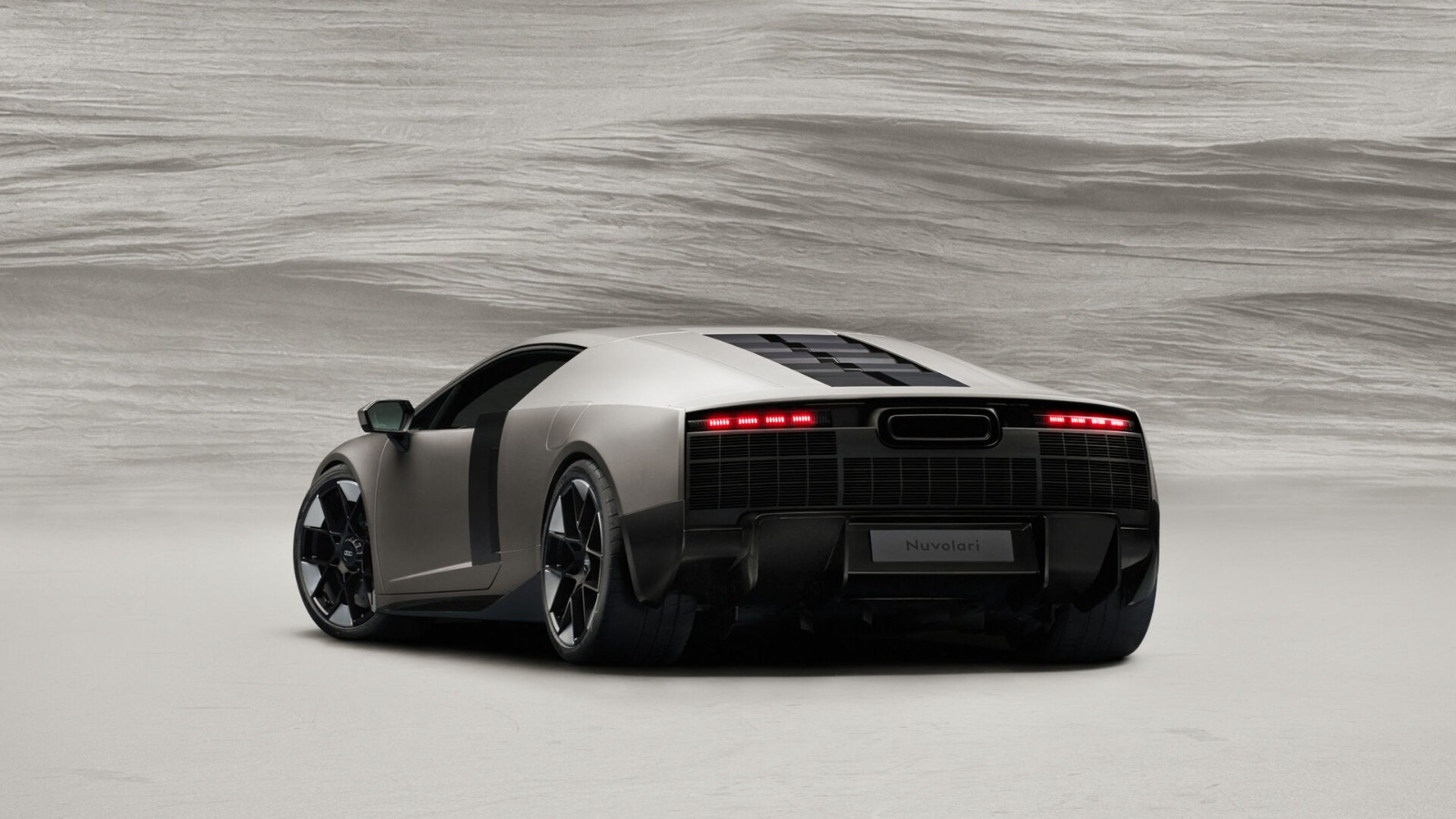
- The Audi Nuvolari* will be the fastest and most powerful production vehicle in the brand’s history.
- Audi CEO Gernot Döllner: “With the Audi Nuvolari*, we are accelerating technological progress, focusing on technology, performance, and execution through teamwork.”
- Audi CTO Rouven Mohr: “Formula 1 is a key impulse to bring innovations to the road quickly and with precision.”
Ingolstadt/Antibes, June 4, 2026 — With the Nuvolari*, Audi is unveiling its first supercar with a high-performance hybrid powertrain — further acceleratingtechnological progress. With 1,001 PS and a top speed of more than 350 km/h, the Nuvolari* is set to become the most powerful vehicle and the fastest production vehicle in the history of the four rings.
Deliveries of the supercar, limited to 499 units, will begin in the first half of 2027.
The Audi Nuvolari* accelerates from 0 to 100 km/h in 2.6 seconds1 and reaches 200 km/hin 6.8 seconds1. These figures are enabled by a range of innovations inspired by Formula 1, including the high-performance hybrid powertrain, quattro predictive ride, active aerodynamics,and the new Audi Space Frame (ASF) with carbon exterior.
“With the Audi Nuvolari*, we are acceleratingtechnological progress,” says Gernot Döllner, Chairman of the Board of Management of AUDI AG. “It shows what is possible when the focus is on technology, performance, and execution through teamwork — and when we achieve progress together.”
Design at its most visceral
As the first production vehicle that follows Audi’s new design philosophy, the Nuvolari* will combine the high-performance character of a supercar with a distinctive design. Taut surfaces, seamlessly integrated technology, and intelligent aerodynamicsdefine its appearance.
The mid-engine layout defines the proportions,resulting in a monolithic volume, a powerful stance, and a strong presence.
The exterior is characterized by Audi’s new signature color Titanium, a paint also used on the Audi Concept C and the Audi Formula 1 race car. In combination with carbon elements, it highlights the precise lines of the Nuvolari*.
High-performance hybrid powertrain with four drive units
The Audi Nuvolari* is powered by a hybrid high-performancepowertrain with a maximum system output of 736 kW (1,001 PS). It combines a 4.0-liter V8 biturbo engine delivering 588 kW (800 hp) with three axial flux electric motors, each producing 110 kW. The lithium-ion battery has a gross capacity of 7.3 kWh.
The combustion engine delivers a maximum torque of 730 Nm and reaches up to 10,000 rpm
— a range previously reserved for motorsports.
Two oil-cooled axial flux electric motors at the front axle deliver up to 2,150 Nm of torque. As an integral part of the quattro system, they support variable torque distribution. A third electric motor between the V8 mid-engine and the transmissioncompletes the drive concept.
The high-performancedrivetrain accelerates the vehicle from 0 to 100 km/h in 2.6 seconds1 and from 0 to 200 km/h in 6.8 seconds1, reaching a top speed of more than 350 km/h.
“With the Audi Nuvolari*, our entire team has once again demonstratedits technical expertise, innovative strength, and dedication,” says Rouven Mohr, CTO of Audi. “This is reflected not only in the vehicle’s performance and its Formula 1-inspired technologies,but also in the ability to transfer innovations quickly and precisely into a production vehicle.”
The quattro predictive ride
The quattro drive is one of Audi’s defining innovations and stands for traction, control, and driving dynamics in all conditions. In the Nuvolari*, Audi further develops this principle and defines the next generation of all-wheel drive with the quattro predictive ride.
The system processes the current driving state based on a highly precise vehicle state model. Detailed sensor data — including steering angle, acceleration, yaw rate (rotation of the vehicle around its vertical axis, which determines steering response in corners), and current grip level — continuously feed into the control system.
If the system anticipates a potential loss of grip in a corner, it responds proactively as an integrated system.
The drive units distribute torque precisely in both longitudinaland lateral directions. The brakes stabilize the vehicle through targeted interventions and reduce slip. The aerodynamics adjust downforce according to the situation.
The electric motors at the front axle are a key element of the predictive dynamics system, enabling variable torque vectoring for agile cornering and stability at high speeds.
The intelligent and predictive tuning of vehicle dynamics ensures maximum traction and control — even during severe lateral and tire slip, on wet or snowy roads, and in changing grip conditions.
Drivers can also influence the system via rotary controls on the steering wheel, with four driving modes that prioritize powertrain, vehicle dynamics, and efficiency differently:
- E-Hybrid enables fully electric driving for urban and short-distance use.
- Balanced combines comfort, efficiency, and performance.
- Dynamic sharpens system responseand enhances agility and precision.
- Dynamic+ focuses the powertrain entirely on an emotional driving experience.
For particularlydemanding scenarios, vehicle dynamics can be further refined in Track Mode. This enables targeted adjustment of traction control to driving style and available grip. The settings range from Wet to Dry and from Race to Traction Control Off (TC Off) — allowing for transparent,controllable driving behavior right up to the physical limits.
Audi Space Frame with carbon exterior
The vehicle architectureof the Audi Nuvolari* is consistently designed for lightweight construction and high torsional rigidity. To achieve this, Audi combines proven Audi Space Frame technology with a carbon exterior — a first for Audi.
The Audi Space Frame with carbon exterior combines low weight with high structural strength, forming the basis for precise handling and controlled high performance. Almost all exterior components are made from carbon fiber reinforced polymer (CFRP).
All carbon fiber components of the Audi Nuvolari* have been developed using Formula 1 expertise. A key element is prepreg autoclave technology, in which pre-impregnated carbon-fibers are shaped and then cured under high pressure and temperature — ensuring maximum structural performance with minimal weight.
The carbon elements are produced in precise, manual layup processes that require a high level of experience, care, and craftsmanship. The quality of execution is crucial for both the structural integrity and the visual appearance of the components.
This manufacturing process enables highly complex geometries. Using CFRP, components canbe designed consistently for function — from complex door panel structures to precisely aligned vertical frame elements that guide airflow through the concealed S-duct.
In areas exposed to particularly high temperatures, the Audi Nuvolari* uses specifically tuned heat-resistant materials that combine functional performance with distinctive visual accents.
Forged center-lock wheels are also making their debut in Audi’s production portfolio.
Active aerodynamics inspired by Formula 1
Audi uses active aerodynamics in the Nuvolari* to purposefully combine performance and efficiency. The system adjusts downforce, drag, and aerodynamic balance in response to driving conditions — ensuring maximum stability and precise vehicle control.
Each exterior element serves a clearly defined aerodynamic function, from the front splitter to the rear diffuser. Audi’s Formula 1 drivers provided targeted feedback during the development phase to fine-tune aerodynamic performance.
Front air intakes ensure effective brake cooling as well as efficient thermal management of the combustion engine and hybrid components. A vented front end, known as an S-duct, improves aerodynamic efficiency at the front axle — delivering additional downforce, reducing lift at high speeds, and improving cooling of the powertrain.
The central element of the active aerodynamic system is the deployable adaptive rear wing. It controls downforce and drag across three configurations: Closed, Low Downforce (LD), and High Downforce (HD).
In the Closed position, the rear wing is retracted to minimize drag and improve efficiency. In LD and HD configurations, different levels of downforce are generated depending on driving dynamics and the selected driving mode.
In performance-oriented modes such as Dynamic, Dynamic+, and Track, the rear wing operates fully automatically.On straights, the system shifts to the LD position to optimize top speed and stability. The Drag Reduction System (DRS), familiar from Formula 1, can be activated manually via a dedicated steering-wheelbutton to further lower the wing, reducing drag and increasing top speed.
Under braking and in corners, the wing moves to the HD position to optimize downforce for maximum performance and control. In this high-downforce configuration, the aerodynamic concept of the Audi Nuvolari* — depending on the driving situation — delivers more than 400 kg of downforce.
The rear wing position can be controlled both automatically and manually via a rotary control on the steering wheel — in all driving modes except E-Hybrid.
The aerodynamics concept hasbeen refined down to the smallest detail — including the solid-metal Audi rings integrated flush into the deployable rear wing — and forms the basis for high cornering speeds and fast lap times on the racetrack.
Dynamic energy management
The energy management system of the Audi Nuvolari* is also inspired by motorsport. Boost and recuperation strategies are closely linked to torque distribution. As an integrated system, it continuouslymanages the interaction between power delivery and energy recovery — adapted to driving conditions, grip level, and driver intent.
Adaptive strategies for coasting and brake recuperationextend energy recovery to nearly all driving phases. At the front axle, electric decelerationtakes on a significant portion of braking, while at the rear axle, coasting, partial load, and traction control phases are used for recuperation.
Purely electric decelerationof up to 0.3 g is possible — covering a large share of braking events in everyday and dynamic driving. This controlled deceleration stabilizes the vehicle while simultaneouslycharging the battery.
The integrated architectureof power delivery, torque distribution, and energy recovery becomes especially evident in the Launch Control function. Here, the system makes targeted use of stored energy for maximum acceleration — a concept derived directly from Formula 1, enabling maximum performance with controlled traction.
High-performance braking system
The braking system of the Audi Nuvolari* has been developed with a clear objective: maximum performance under extreme conditions through precise interaction between hydraulic braking and electric deceleration.
A motorsport-inspired brake-by-wire system enables variable distribution between recuperation and hydraulic braking. The brake pedal is functionally decoupled from actual braking force at the wheels to ensure a consistent and precise pedal feel.
At the core of the system is the new Audi Ceramic Pro braking system, designed for consistently high deceleration and precise control — even under sustained intense use on the racetrack.
At the front axle, ten-piston fixed calipers work with 420 × 40 mm brake discs, while at the rear, four-piston calipers are paired with 410 × 32 mm discs. This combination delivers balanced braking performance with high thermal stability and precise pedal feedback across the entire speed range.
The brake discs, derived directly from Formula 1, are based on a long-fiber carbon structure designed to withstand extreme thermal loads without compromising structural integrity or consistent friction characteristics.
A specially designed internal cooling system for the brake discs improves airflow and increases heat dissipation by up to 21 percent compared with conventional carbon-ceramic systems.
Reduced longitudinalvibrations under heavy braking, improved directional stability, and precise steering response shorten braking distances — particularly at high speeds — while increasing control and safety.
Under suitable conditions, a significant portion of decelerationis provided purely electrically. Only under higher braking demands or near the limits of vehicle dynamics does the system seamlessly bring in the hydraulic brakes.
With an energy absorption capacity of up to 2.8 megawatts, the braking system is capable of handling extreme deceleration loads — on par with a current Formula 1 car. This ensures consistently high braking performance without fading or overheating,even under extreme track conditions.
Interior and UI/UX
The interior of the Audi Nuvolari* is fully focused on the act of driving. A reduced architecture concentrates all controls on essential functions and positions them directly within the driver’s field of view — including key elements of the human machine interface (HMI).
This driver-centricapproach prioritizes relevant information, while secondary content remains in the background. Digital displays and physical controls follow a consistent logic, enabling natural interaction.
Color accents in the HMI are a nod to the legendary Auto Union Type C race car, referencing the motorsport era of the 1930s, which was dominated by historic speed records.
This functional use of color is continued in the overall interior concept, dividing the cabin into two zones. The front section is finished in a deep, dark tone, designed to support concentration. Surfaces, materials, and accents are consistentlyaligned with this dark color scheme. In contrast, the rear section introduces a lighter tone, Shadow Dune.
Precision and craftsmanshipdefine the entire interior — from controls and air vents to the frame of the central display, crafted from anodized aluminum.
Lightweight seats complement the driver-orientedinterior concept. The carbon fiber structure in the seat base and backrest reduces weight while providing high rigidity and precise lateral support. The ergonomic design promotes a natural seating position and enables direct feedback from both vehicle and road.
Tazio Nuvolari
The Audi Nuvolari* stands for uncompromising performance and absolute focus. The pre-production prototype presented today was developed in a remarkably short time through close international collaboration.
It is named after Tazio Nuvolari, one of the most prominent figures in motorsport history. Born in Italy, he was known for his fearlessness, ingenuity, dedication, and a single-minded will to succeed.
1Under specific conditions (battery initial temperature > 28 °C and a state of charge (SoC) above 80%)
Further information and backstory related tothe Audi Nuvolari* canbe found inthe press kit.
Oscar da Silva Martins
Head of Product and Technology Communications Phone: +49152 01659962
Email: oscar.martins@audi.de
About Audi
Audi drives transformation and shapes the mobility of tomorrow – with intelligent, electric products.
The premium automotive brand is available in more than 100 markets. Its global production network spans 21 sites in 12 countries. Vorsprung durch Technik unites more than 88,000 employees. With courage, passion, responsibility, and trust, they are reinterpreting more than 100 years of automaking tradition for the future. In 2026, Audi is entering Formula 1 with a factory team in a bold expression of its motorsports DNA.
The Audi Group also includes the supercar manufacturer Lamborghini, the luxury brand Bentley Motors, and the motorcycle maker Ducati.
Learn more about the Audi Group here.
Fuel/electric power consumption and emissions values of the models named above:
Audi Nuvolari:The vehicle shown is a near-production prototype.
Fuel consumption combined (weighted) in l/100 km: 11.3 (preliminary); Power consumption combined (weighted) in kWh/100km: 7.8 (preliminary); CO₂ emissions combined (weighted) in g/km: 270 (preliminary); CO₂ class combined (weighted): G (preliminary); Fuel consumption with discharged battery in l/100 km: 14.7 (preliminary); CO₂ emissions with discharged battery: G (preliminary).